
The protein p53 is the product of the gene, TP53. Mutation in the TP53 gene has been associated with the pathology of several malignant cancers.
TP53 is classified as a tumour-suppressor gene – it acts as a ‘brake’ during the cell cycle, and prevents cells from replicating too quickly. All human cells, apart from gametes (which are haploid), carry two functional copies of the TP53 gene.
TP53 is called the ‘guardian of the human genome’ because it promotes genome stability. It is activated under conditions of cell stress, for example, DNA damage, exposure to mutagenic agents or oxidative stress. When activated, the TP53 gene produces the p53 protein.
p53 acts as a Transcription Factor, and can switch on other genes that modulate the cell cycle. The protein has a DNA-binding domain, which is used to bind to promoter regions of genes. p53 can bind to around 100 genes in the cell. These genes might either be activated, or repressed. This includes, amongst others, genes regulating cell-cycle checkpoints, apoptosis and DNA repair.
One way p53 regulates the cell cycle is by halting the cell cycle if it detects damage to DNA. This prevents cells with damaged DNA from replicating further.
Damage to DNA can result in errors in DNA replication, which can introduce mutations in the genome. Some mutations give the cell the ability to divide in an uncontrolled manner. Rapid, uncontrolled, cell growth leads to tumours, which can turn into malignant cancers.
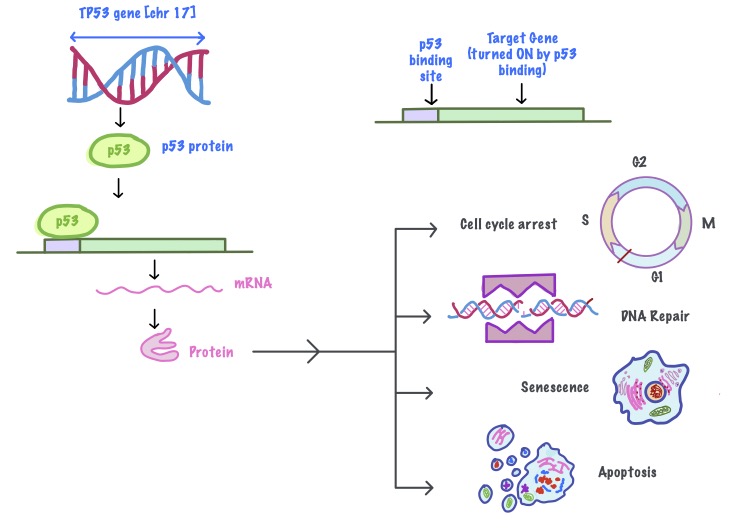
p53 acts between the G1 (growth phase) and S (DNA synthesis) phase of the cell cycle. If p53 recognises damage to DNA, it halts the cell cycle between the G1 and the S phase. This gives DNA repair enzymes time to repair DNA, before the cell cycle continues.
If DNA is beyond repair, or if repair might lead to a lot of errors in replication, p53 can trigger a process called Apoptosis. Apoptosis is a process of cell self-digestion – the DNA and organelles break down, and the membrane starts to bleb outwards. The cell breaks apart into apoptotic bodies, which are digested by macrophages.
The majority of TP53 mutations in human cells are missense mutations. A missense mutation of the TP53 gene results in some amino acids in the polypeptide sequence of p53 protein to be replaced by different amino acids. This means the p53 protein cannot fold into its correct tertiary structure.
Mutation in the DNA-binding domain of the gene means the p53 protein can no longer act as a transcription factor to turn on genes. This results in the cell losing the ability to control the checkpoints, loss of DNA repair abilities, and inability of undergo apoptosis if the DNA is damaged. Loss of apoptotic pathways allows damaged cells to keep replicating, prolonging the life of tumour cells.
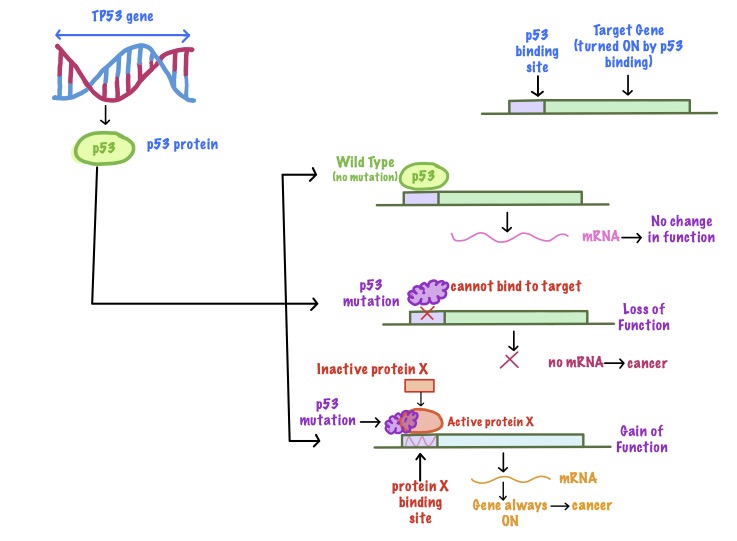
Some missense mutations of the TP53 gene result in a variant of the p53 protein that is beneficial to the (cancer) cell. For example, this new p53 variant can interact with, and activate, other transcription factors, turning on some genes permanently and altering the transcription abilities and metabolic limits of the cancer cell. This might give cancer cells the ability to self-renew independently and infinitely, unlike non-cancerous human cells, which can only divide for 40 to 60 life cycles (the Hayflick limit).
Mutations in TP53 can also confer resistance to common chemotherapy drugs, like cisplatin and EGFR-inhibitors. This can pose challenges in cancer treatment.
REFERENCES
- Reisman (2012), Transcriptional Regulation of the p53 Tumor Suppressor Gene in S-Phase of the Cell-Cycle and the Cellular Response to DNA Damage.
- Williams (2016), p53 in the DNA-Damage-Repair Process.
- Aubrey (2017), How does p53 induce apoptosis and how does this relate to p53-mediated tumour suppression?
- Hientz (2017), The role of p53 in cancer drug resistance and targeted chemotherapy.
- Mantovani (2018), Mutant p53 as a guardian of the cancer cell.
- Mijit (2020), Role of p53 in the Regulation of Cellular Senescence.
- Zhu (2020), Mutant p53 in Cancer Progression and Targeted Therapies.
- Marei (2021), p53 signaling in cancer progression and therapy.
- Wang (2022), Should mutant TP53 be targeted for cancer therapy?
- Zawacka-Pankau (2022), The Role of p53 Family in Cancer.
- Attardi (2023), Targeting p53 gain-of-function activity in cancer therapy: a cautionary tale.
 bristolsciencetutor.com