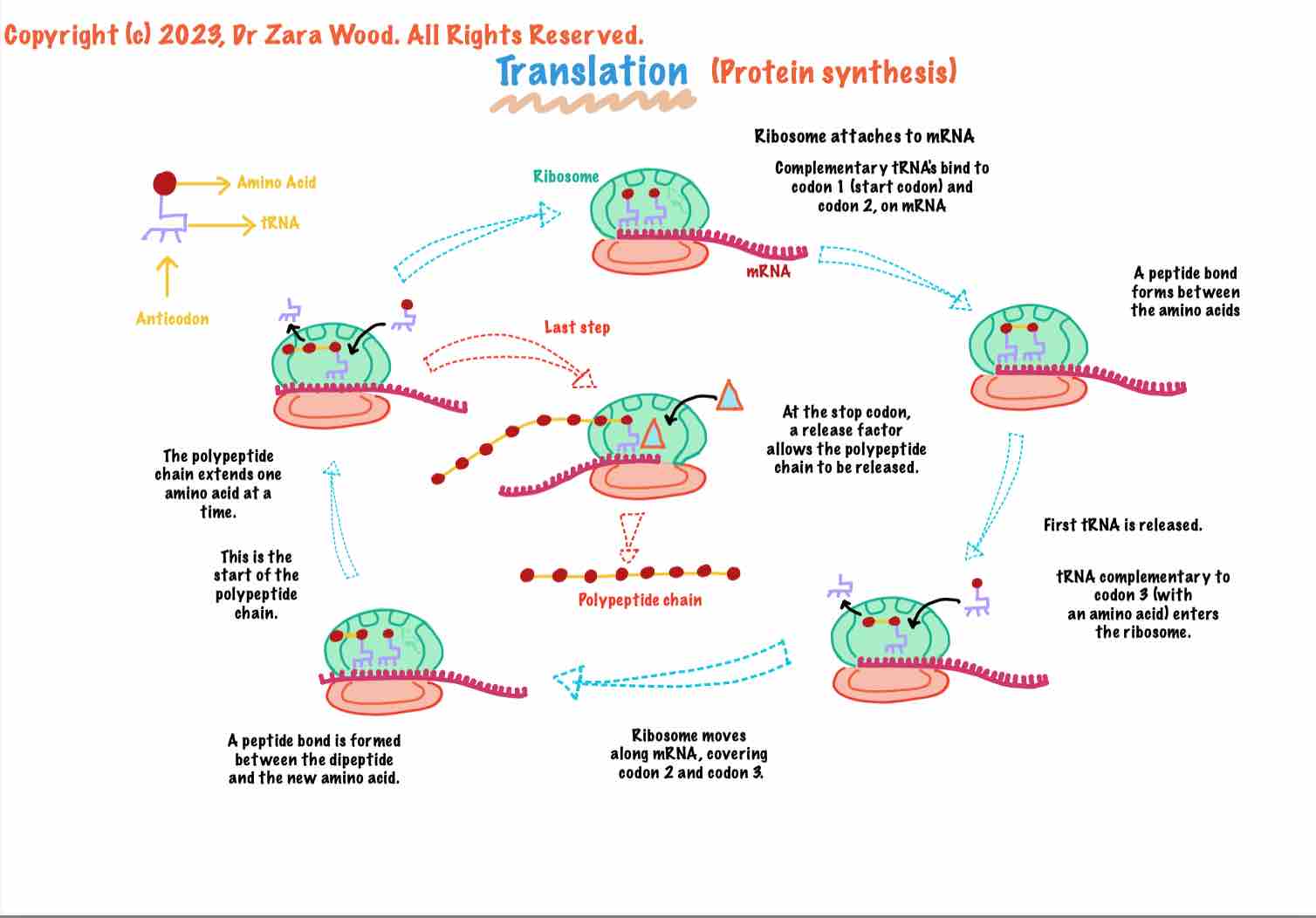
Translation is the process of converting the information on messenger RNA (mRNA) into a string of amino acids, called a polypeptide chain.
Initiation
- At the start of Translation, the ribosome interacts with the start codon and attaches to the mRNA, along with an initiator tRNA. The initiator tRNA has an anticodon complementary to the start codon, which is usually AUG.
- Each tRNA also carries an amino acid.
- The start codon codes for the amino acid Methionine, in Eukaryotes.
Elongation
- An amino-acid-tRNA, complementary to codon 2, attaches to the mRNA using hydrogen bonds.
- A peptide bond is formed between the first two amino acids.
- The first tRNA exits the ribosome. The next amino-acid-tRNA enters the ribosome, and attaches to codon 3.
- The incoming amino acid is linked to the newly-formed polypeptide chain.
- The process repeats, and amino acids are added one at a time to the growing polypeptide chain.
Termination
- When the ribosome reaches the stop codon, translation slows down.
- This gives time for a release factor to bind to the ribosome.
- The polypeptide chain is released, and the ribosome re-starts translation on another mRNA.
You can find a full sized mind-map of the process of translation on this page.
 bristolsciencetutor.com